Tuesday, September 8, 2015

Deja vu. 2011 and 2015

In 2011, we published a study highlighting the need to reconsider using the term of "shoulder impingement" Link

 In August of 2015 the JBJS published a commentary about the classic article published by Charles Neer on acromioplasty. Link

We are glad that the leadership of the Journal of Bone and Joint Surgery adopts our suggestion to stop using the term.

Attached please see the last paragraph from the "Classics documentary"

Neer’s hypothesis that impingement caused most rotator cuff tears does not appear to have withstood the test of time, however. Arthroscopy and magnetic resonance imaging arthrography have elucidated many other conditions that cause shoulder pain that were previously misdiagnosed as impingement. Consequently, the liberal use of acromioplasty to treat “impingement” is being replaced by a trend toward making an anatomic diagnosis, such as a partial or complete tear of the rotator cuff, and performing aggressive rehabilitation prior to corrective surgery.

Friday, August 14, 2015

Reverse shoulder replacement for irreparable rotator cuff tear with high riding humeral head

Rotator cuff deficiency with a high riding humeral head remains a challenging problem to solve. Shoulder replacement surgery in those individuals is highly technical in terms of correct positioning of implants or soft tissue balancing. Muscle transfers is an alternative solution in the treatment of the rotator cuff deficient shoulder as they can increase the range of motion of shoulder, however they have unpredictable results and they do not address the arthritic pain. If there is arthritis at the glenohumeral joint then is it unlikely that a muscle transfer will provide better quality of life. 

A reverse shoulder replacement can provide solution in cases that the active elevation of the arm is below 90 degrees. Further reading at the JBJS study:  http://dx.doi.org/10.2106/JBJS.K.01206


It must be highlighted though that if the active elevation of the shoulder is at 90 degrees or more then a reverse shoulder replacement may not provide significant benefits.

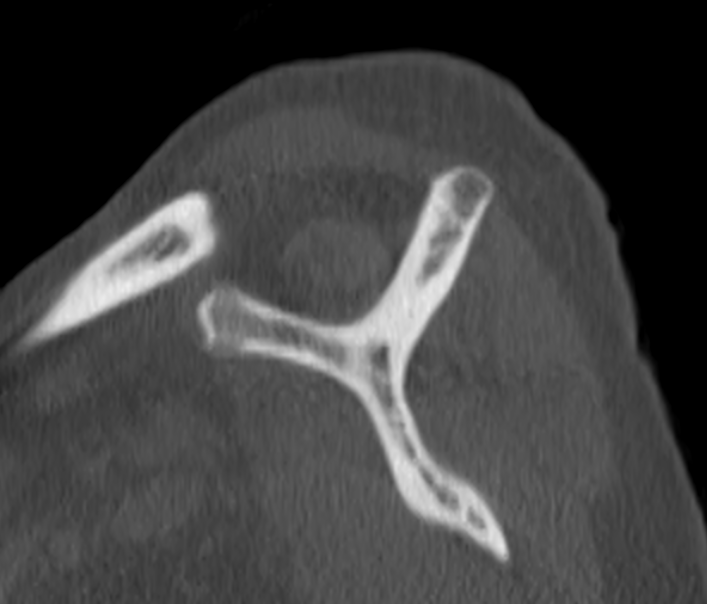
Below is an example of an elderly person with loss of motion (<90 degrees) and a high riding humeral head treated with a reverse shoulder replacement. The coronal CT shows the high riding humeral head and the sagittal oblique CT shows the significant atrophy of the supraspinatus and the contact of the humerus with the acromion making the repair of the rotator cuff impossible (Goutallier stage 3)


Saturday, June 20, 2015

Nature nanotechnology. Detecting bacteria on implants. Timing!


A magneto-DNA nanoparticle system for rapid detection and phenotyping of bacteria


One of the most devastating experiences that an orthopaedic surgeon encounters is the infected implant. More importantly, the patient goes through extensive surgery that most of time is of inferior result compared to the first surgery. The socioeconomic cost of the infections in orthopaedics is tremendous. The annual cost of infected revisions to US hospitals is projected to exceed $1.62 billion by 2020.

Often times it is difficult to confirm the presence of bacteria in a wound just by inspecting the color of the fluid, the odor or the macroscopic appearance of the membranes on the implants. There is promising technology being developed that will give us the opportunity to detect an infection in less than 2 hours when currently a standard microbiology lab can give us an answer in 2-3 days and sometimes depending on the micro-organism in 14-21 days.

The magneto-DNA nanoparticle system provides an answer in less than 2 hours. The ideal test would have been similar to a pregnancy test that will give us an answer at the time of surgery. In that scenario orthopaedic surgeons will be able to manage periprosthetic infections more effectively, develop better algorithms and lower the cost of revision arthroplasty care from a financial and social perspective.

http://www.nature.com/nnano/journal/v8/n5/full/nnano.2013.70.html#f5

Friday, June 19, 2015

My experience at the AANA Masters Elbow Course 2015


Recently, I had the honor to be an invited instructor at theLearning Center of the American Academy of Orthopaedics Surgeons. Masters Course AANA 2015 on elbow arthroscopy.

I recall that in the 1990s many surgeons thought that arthroscopy will be something temporary, a trend that will go away as many "new technologies" do. I also recall that arthroscopic surgery was approached with negativity or even skepticism even in the 1990s. During the time I spend at the AAOS Learning Center as an instructor on elbow arthroscopy I thought that being negative has no place in science and medicine. I remember the lecture of Dr Gary Poehling on elbow arthroscopy at the institution where I was trained (WFUBMC) and the first arthroscopes that were introduced in the US and imported from Japan. They were bulky, they will break and they will not be suitable for small joints. In addition, the quality of imaging was poor for diagnosis.  I do not think anyone would have imagined the potential of arthroscopic surgery at that point. 

Thirty years later arthroscopy of small joints has come long ways. While I was teaching fellows how to establish portals safely around the elbow, which is considered a difficult joint to scope, I realized that arthroscopy has even greater potential. I believe that the cameras and instruments will become smaller in size in the future, the ability to navigate the elbow will improve and the arthroscopic repair of collateral ligament ruptures or even fixation of shear fractures of the capitellum will become a reality. Some may think that I am very optimistic. The ones who belong to the arena of electronics and computer science know that we are not far away from manufacturing surgical instruments and arthroscopes that will have the diameter of a spinal needle. In my opinion it is exciting what the future will bring us. Negativity has no place in medicine.  

Subluxating ulnar nerve

Subluxation of the ulnar nerve at the elbow can be seen in 12-15% of the normal population and can be asymptomatic. The nerve usually subluxes in flexion as seen in this video. If the patient has no symptoms and no neurologic findings then surgery is not indicated. It may be associated with snapping of the medial triceps.

The clinical importance of this condition is the following:

1. In case elbow arthroscopy is planned the proximal medial portal can result in ulnar nerve damage which may lead to permanent dysfunction of the hand/arm

2. If symptomatic and presentation mimics cubital tunnel syndrome findings then it is important to evaluate intra-operatively what makes the ulnar nerve sublux. This is performed by exposing the ulnar nerve proximal to the medial epicondyle and flexing the elbow while inspecting the wound. Sometimes snapping over the medial triceps or intermuscular septum may be seen.

It is commonly seen in throwers and bodybuilders and surgery is necessary if symptomatic.

Wednesday, May 20, 2015

A true healthcare reform is needed. The cost of defensive medicine

"Jackson Healthcare, a healthcare solutions company, surveyed physicians on defensive medicine practices between October 2009 and May 2011. Their survey found that between 73 and 92 percent of all physicians practice some form of defensive medicine, at a cost of between $650 to $850 billion dollars in unnecessary expenditures, accounting for between 24 and 36 percent of our nation’s $2.5 trillion annual healthcare bill."