Monday, January 22, 2018

Osteoporosis and collapse of the head after ORIF of the proximal humerus fracture

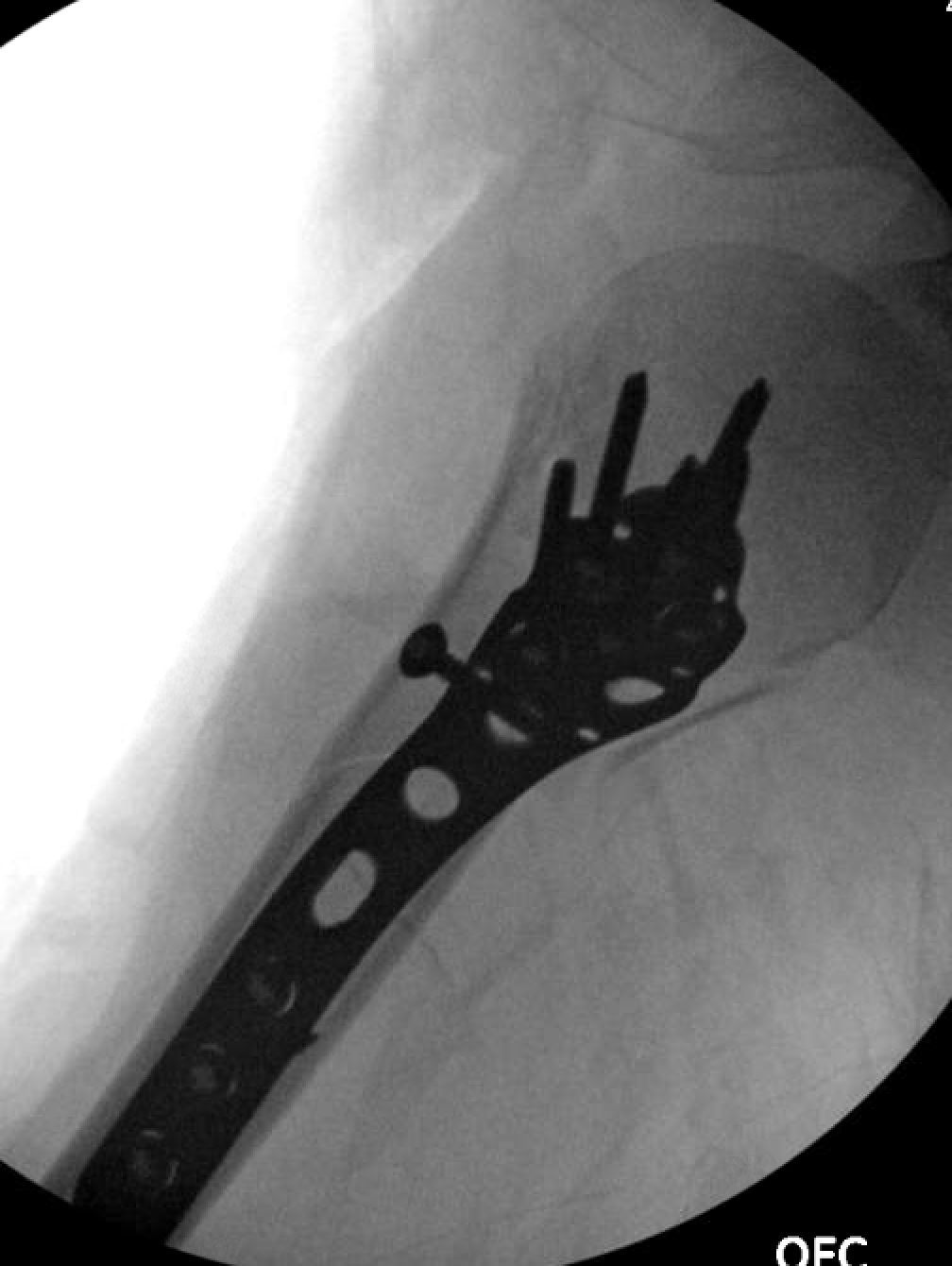
The following case illustrates the problem of the osteoporosis in the treatment of the proximal humerus fractures. In addition, it highlights the need to avoid approximation of the articular surface with the proximal locking screws if a locking plate is used for the treatment of this fracture. In this case due to the young age and smoking status of the patient which would have compromised the healing of the tuberosities a hemiarthroplasty was not chosen.


3 months 


4 months post op the hardware was removed to avoid penetration of the humeral head articular surface with the screws.


Short stems in anatomic total shoulder arthroplasty.

Short stems in anatomic shoulder replacement provide the advantage of avoiding the insertion of the stem at the curved area of the proximal humerus thus avoiding reaming of the cortices . This provides the theoretical advantage of protection of the cortical bone from from stress risers. In addition, the mismatch between the diaphyseal and metaphyseal area of the humerus is eliminated as the fixation is achieved in the metaphyseal area. It remains to be seen whether "distal fixation" is not necessary - at the tip of the stem, as this type of implant has no distal fixation. We use this stem in patients with good bone stock and no severe osteopenia with the idea that if future removal of the stem is required then revision surgery will be easier. In addition, the periprosthetic fracture below the stem should be less of a problem with this implant.

Szerlip BW, Morris BJ, Laughlin MS, Kilian CM, Edwards TB. Clinical and
radiographic outcomes after total shoulder arthroplasty with an anatomic
press-fit short stem. J Shoulder Elbow Surg. 2018 Jan;27(1):10-16. 


Non operative treatment of the fracture of the surgical neck of the proximal humerus

Non operative treatment of proximal humerus surgical neck fractures can and should be offered for patients who are reliable and are willing to follow up with serial x-rays. The following fracture was healed in 7 months cradio-graphically. "Clinically", it was healed at 6 weeks. The range of motion was active FE to 160 degrees without pain.


Another case below is presented with serial radiographs and progressive healing.


Sunday, January 21, 2018

Operative management of the fractures of the surgical neck of the humerus

This type of fracture requires operative approach if the patient is active. Proper reduction in order to achieve good results in terms of function and pain are the goals of surgery. It is not uncommon for patients to complain of severe pain after this injury. In the osteoporotic patient population this injury can be the result of low energy trauma, in the young and healthy individual it is usually the result of high energy trauma.  

The decision for surgery should also include the functional demands of the patients, the presence of comorbidities, and the ability to undergo operative treatment.
Indications for hemiarthroplasty do not apply for this fracture

Due to severe osteoporosis the fixation was lost, the fracture went into varus but eventually healed in the varus position. This patient had severe loss of bone from chronic use of oral corticosteroids


Tuesday, October 31, 2017

Proximal humerus fracture dislocation with malunion of the humeral head in the subscapularis recess

This patient presented with a chronic anterior dislocation of the humeral head after a proximal humerus fracture, the humeral head was malunited in the subscapularis recess. Osteotomy of the humeral head was required to remove the bone from the anterior glenoid. The fracture was addressed with hemiarthroplasty and repair of the tuberosities. The use of a stem that provides a "window" for proximal bone grafting, the removal of the cement circumferentially from the proximal stem during implantation, and the stable suture repair of the tuberosities with Fiberwire provided a good outcome with union of the tuberosities. The anterior inferior subluxation of the humeral head persisted for 6 months but eventually it was resolved. Contrary to the belief that this is the result of a "fracture hematoma" it seems that this finding is associated with muscle atony or contusion of the rotator cuff or axillary nerve neuropraxia. X-rays are shown below. 


Monday, October 30, 2017

Locked proximal humerus fracture dislocation

Fracture locked dislocations of the proximal humerus are challenging injuries due to the energy of the trauma and the instability that is encountered during surgery. Small bony bankart lesions as in this case do not need to be fixed. The progressive development of stiffness usually balances the instability. If the fracture fixation is combined with labrum or bankart repair then there is a concern for development of significant stiffness. The following x-rays demonstrate a patient who was treated with ORIF of the humerus fracture and no repair of the small bony bankart lesion. She regained active elevation of her shoulder to 160 degrees without instability.